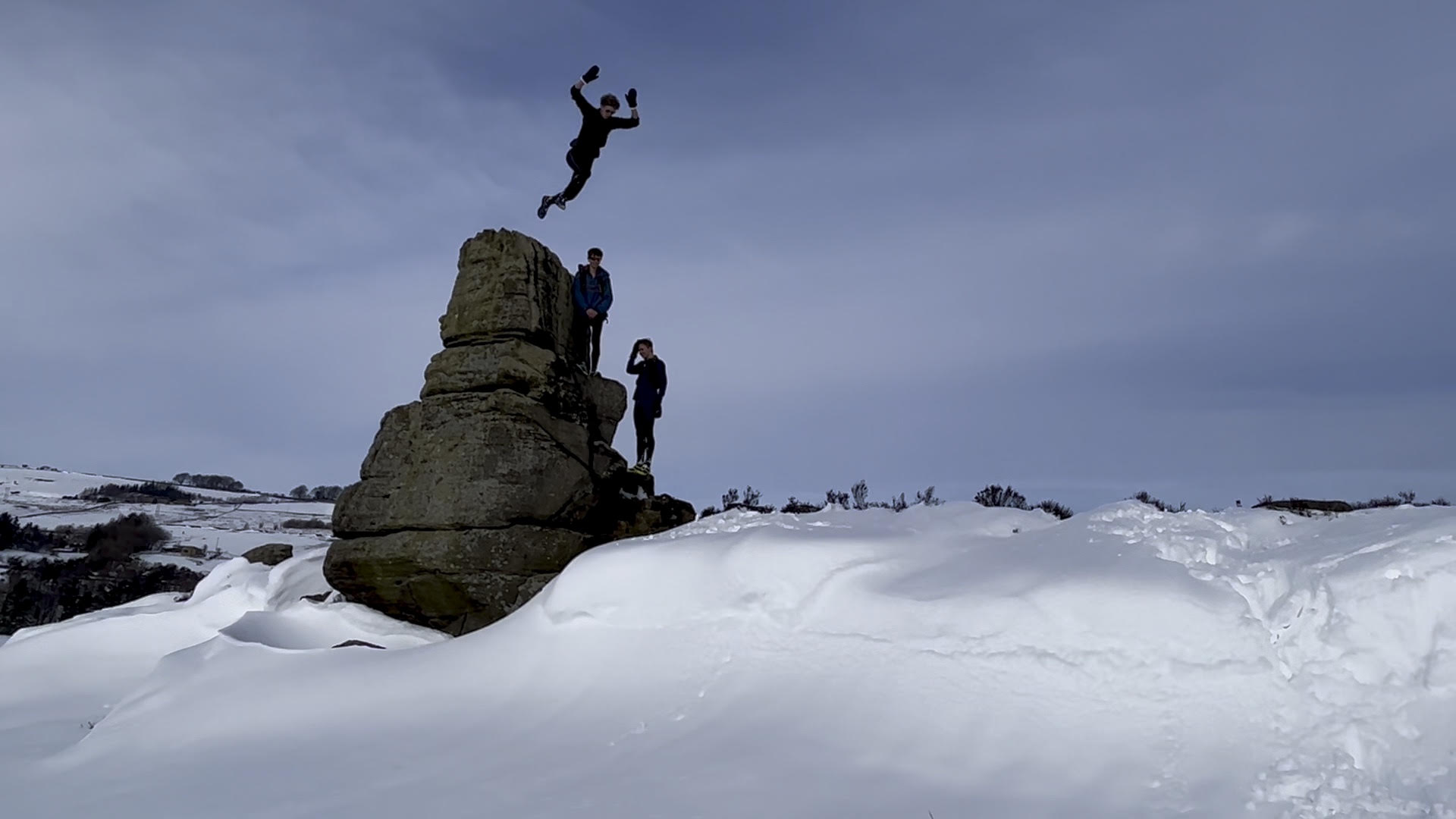
Outside of the hut, the Headstone has potential to be one of DPFR’s most frequently visited landmarks. Accessible from a range of directions it makes a perfect checkpoint for club runs and races alike. Situated on Hallam Moor, the Headstone is a large naturally occurring grit stone column, surrounded by other small rocks. It’s various fissures and cracks mean that from certain angles, these give the appearance of crude facial features and thus the name Headstone. Each Christmas the club runs to the Headstone to sing traditional carols before returning to the safety of The Sportsman for curry and beer. It also features in the Rivelin Landmarks Club Race, The Bradfield Boundary Run and is the namesake of the currently dormant race, the “Headstone Headache”.
Interestingly, other names seem to exist in local history and folklore:
Stump John / the Priestley Stone?
Named after John Priestley, a former owner of Overstones Farm near Stanage (His family were instrumental in founding the Longshaw Sheepdog Trials)
Cock Crowing Stone?
There are a few suggestions for this name, none with much substance but this adds to the magic of it all!
-Pagan sacrifice of Cockerels
-Male grouse “cocks” courting from its summit
-There seem to be a few stones around Northern England that share this name, and the folkore states that these stones turn around or even come to life when they here a cock crow. Some only on certain days of the year at sunrise and others daily.
In the book Strange South Yorkshire’ by David Clarke, he speculates that ” the ‘face’ on the stone is most striking in morning light gave rise to the idea of the face ‘appearing’ in the morning as the stone turned”
Mentioned in the Clarion Ramblers Handbooks…
Clarion Handbook 1923 Page 077.
Stump John or Cock Crowing Stone.
Stump John or the “Cock Crowing Stone,” on the 6 in. to m. map, is now called the Head Stone (1), altitude 1075 feet. It stands 200 yards to the West of the footpath from the Ocean View Cottage (Redmires,) to Surrey Farm, and, as seen from near this latter point, is a prominent object on the moor slope.It is thus described in Johann Zimmermann’s “Historical and Antiquarian Sketches of the Neighbourhood of Sheffield,” published in 1863. See copy in vol. 10 of local pamphlets – Jackson collection, in Sheffield Reference Library.
“Stump John,” or what is usually called the “crow-cocking stone,” is a massive pillar on the edge of the moors beyond (2), placed perpendicularly on the rock which forms its base. It would be a prominent guide when the whole of this district was wild moorland forest. The action of the weather has formed its top into a series of perforations which almost resemble the honeycomb decorations of the Alhambra.”
(1) This seems to be another map alteration of an interesting name. The proper name is Stump John, or the cock crowing Stone, and probably because the cock grouse often make their calls from this well perched rock. I am not aware of the origin of Stump John.
(2) “Beyond” means west of the Rivelin Reservoirs, misnamed Hollowmeadows Reservoirs.
Clarion Handbook 1939 Page 082.
One day, after the article in the 1933 Handbook was printed, I was talking to our Holmesfield character, FERDINAND SILCOCK, and mentioned ” PRIESTLEY’S STONE” to him.
At once he said that, probably fully forty years ago, when he was engaged as a beater for the grouse shooting on White Path Moss and Burbage Moors, he and ” Tommy Raandeaad ” (THOMAS MARSHALL, of Dore), used to bury a bottle of beer near this “PRIESTLEY STONE ” after each shoot and leave it there until the following year.
Said ” Ferdy ” ” it wer’ proper ‘ stingo ‘ next year. Ah carried t’beer an’ Tommy carried t’birds,” and you bet ” Ferdy ” had his share of that beer.
The beaters, he said, used to ” flag ” near PRIESTLEY’S STONE, and flank the flying grouse towards the shooting butts.
Ferdinand also informed me that the name they knew for Priestley’s Stone was “Stump John,” and this gives corroboration for the statement I made that the Stone, or ” Stump,” was named after JOHN PRIESTLEY, of Overstones Farm.
References: https://hypnogoria.com/folklore_headstone.html